2017 - Karnataka Government Funds released to Churches list


Karnataka - Christian Development Program as on April 2018

Reference:
https://gokdom.kar.nic.in/ChristianDevelopment.asp#

Below is screenshot from government website.


Karnataka Government Contributions to Minorities 2014-2018


Reference:


CONTINUED:


2018: BJP increases minority budget by 62%


Reference link:

https://timesofindia.indiatimes.com/business/india-business/62-increase-in-funding-for-minority-affairs-in-union-budget/articleshow/62742314.cms

BHOPAL: Fifteen new schemes have been rolled out for minority development in Finance Minister Arun Jaitley's Budget and the NDA government for 2017-18.
Aiming at education and skill development the budget has increased funding of ministry of minority affairs by whopping 62%. "It is the largest increase in a union budget for minority development. It is aimed at development with dignity and empowerment without appeasement," union minority affairs minister Mukhtar Abbas Naqvi, told TOI.


Uttar Pradesh CM Yogi Adityanath to provide financial assistance for poor muslims marriage


Working towards its promise of Sabka Saath, Sabka Vikas, the BJP government in Uttar Pradesh is focusing on minority welfare.
The Uttar Pradesh government under Yogi Adityanath will provide monetary assistance to poor Muslim families for their daughter's marriage.
The government also plans to organise mass weddings for them under a scheme which will be run jointly by the Central government.    
Video link:
http://indiatoday.intoday.in/video/cm-yogi-adityanath-muslim-weddings-mehar/1/928081.html

SADBHAVNA MANDAPS
A month since coming to power in Uttar Pradesh, the Yogi Adityanath government has chalked out a roadmap for inclusive development.
As part of the pilot, the Yogi Adityanath government is planning to organise 100 mass weddings across all the districts of Uttar Pradesh at 'Sadbhavna Mandaps'.
If the scheme receives a good response, the government plans to make it a bi-annual affair. Sources said the scheme is meant for poor Muslim families.
IT WAS THE CM's IDEA
Till now, the state government was providing a financial assistance of Rs 20,000 to below-poverty line (BPL) families for their daughter's marriage. Many alleged that the scheme was marred by corruption and had little representation from Muslim families.
Mohsin Raza, the Minister of State for Minority Affairs in the Yogi Adityanath cabinet, said the idea to organise mass weddings for Muslim girls came from the chief minister himself.
"I am extremely happy that the chief minister made the proposal of Sadbhavna Mandap," said Mohsin Raza.

Reference:

http://indiatoday.intoday.in/story/yogi-adityanath-mass-weddings-for-poor-muslims-sadbhavna-mandap/1/928156.html

Telangana Chief Minister KCR passes bill for 12% quota for Muslims - Apr 2017

Reference:
http://www.thehindu.com/news/national/telangana/telangana-assembly-passes-bill-to-hike-muslim-quota-to-12/article18071406.ece


The reservations for the Scheduled Tribes in educational institutions and government jobs has been increased from 6% to 10%.

The Telangana Legislature on Sunday passed the Bill enhancing the reservations for Muslims and Scheduled Tribes (ST) to 12% and 10% respectively for admission into educational institutions and for the State services.

By doing so, the government has fulfilled one of the major assurances given by Chief Minister K. Chandrasekhar Rao in the run up to the previous elections.

Currently, reservations for Muslims is at 4%, while for Scheduled Tribes, it is at 6%.

The Bill, termed as historical by the ruling TRS and the MIM, received support from the Congress and the CPI (Marxist) even as the BJP opposed the Bill claiming that reservation on the basis of religion was against the constitutional norms. Five BJP members were suspended from the House when they tried to obstruct the proceedings by raising slogans and displaying placards after they were not allowed to speak.

Piloting the Bill, the Chief Minister said the Bill was proposed to address concerns expressed over the inclusive development of marginalised population as the proportion of Scheduled Castes, Scheduled Tribes and minorities — especially Muslims — had increased post bifurcation. This was mainly on account of higher concentration of these communities in the new State when compared to Rayalaseema and Andhra regions of the erstwhile united State.

The population of the STs, for instance, increased to 9.08% post bifurcation as compared to 7.11% in the undivided State. The share of Muslim population too increased from 9.56% in the united State to 12.68% (population of 44.64 lakh) after the formation of Telangana. The Government had constituted commissions of inquiry headed by retired IAS officers G. Sudhir and S. Chellappa to examine the special measures including enhancement of reservation for socially and educationally backward classes/communities as also for SCs and STs for uplifting them from backwardness.

The Commission had observed that Telangana had much higher proportion of BCs/weaker sections, particularly under the E category and revealed that they suffered more discrimination and deprivation. It had recommended provision of an additional 6% reservation for the BC (E) group. Mr. Chellappa’s commission which studied the situation of the STs extensively recommended enhancement of reservation for tribes from 6% to 9.08%.

The Chief Minister said the Government was working out modalities for enhancing the quota for SCs and backward classes too and a study had already been commissioned in this regard. Modalities for enhancing quota for these sections would be announced soon after the receipt of recommendations on the condition of these sections and the Government had fixed a timeline of six months for the completion of the entire process, Mr. Rao said.

IANS adds...
After the state legislative council passes it by late Sunday evening, the Bill will be sent for the President’s assent with a request to include it in the 9th Schedule of the Constitution as was done in the case of Tamil Nadu.

Replying to debate on the bill, Chief Minister Chandrasekhar Rao said if the Centre refuses to accept Telengana’s request, the state would approach the Supreme Court.

Mr. Rao said, “Tamil Nadu is implementing 69% reservations for over two decades. Five to six states are providing more than 50% reservation. How can you deny this to Telangana?”

The Supreme Court has put a cap of 50% on all reservations both at the Centre and in the states.

The Chief Minister clarified that the reservations were being provided purely on the basis of socio-economic backwardness and not on the basis of religion or caste as some parties were project before the people.

Terming it as a historic day, Mr. Rao said the Telangana Rashtra Samithi (TRS) had during the election campaigns promised that quota for the Backward Classes (E) and the Scheduled Tribes will be increased in proportion to their population in the state.

He assured the Backward Classes that there will be no injustice to them because of increase in quota for the BC (E) and announced that the quota for the BCs too will be increased. The State government has directed the Backward Classes Commission to submit a report within six months.

Mr. Rao also said that the reservation for the SCs, who constitute 16.3% of the state’s population, will be increased by 1%. He said the government would soon constitute an SC Commission.

The SCs are currently enjoying 15% reservations while the BCs have a total quota of 25%.

The legislation will increase the total reservations in the State to 62%.

The Chief Minister argued that there is no constitutional bar on providing more than 50% reservation.

Mr. Rao said with 90% of Telangana’s population comprising the Backward Classes, SCs, STs and minorities, the State definitely needed more than 50% reservation, and pointed out that states like Tamil Nadu and Jharkhand were already providing more than 50% quota.

The Telangana Chief Minister made it clear that he will not beg the Centre but will fight to get the new quotas included in the 9th Schedule.

KCR, as the Chief Minister is popularly known, said Telangana would raise this issue at the meeting of the Niti Aayog and in Parliament. He hoped that a debate on the issue will begin and consensus will build at the national level.

He defended the State’s hike in quota for Muslims and hit back at the BJP for opposing it.

“Why can’t we give them reservation? Why should they be denied reservation just because they are Muslims? Are they not part of this country,” asked Mr. Rao in the absence of all five members of the BJP, who were earlier suspended for the day by the Speaker for disrupting the proceedings.

He pointed out that India has the largest Muslim community in the world and even some of the so-called Islamic countries do not have such a large Muslim population.

KCR said the promise to increase the Muslim quota was part of the TRS manifesto and people approved this agenda by giving their mandate to the party.

The All India Majlis-e-Ittehadul Muslimeen (AIMIM) suggested that the government take steps to protect the existing 4% reservation while increasing the quota by 8%. Its member Ahmed Pasha Khadri said a new category BC (F) be created for hiked quota.

The Chief Minister, however, said there was no need for any apprehensions as there will be no threat to the existing four 4% reservations.

1000 Crore Ramzan Relief To Hyderabadi Muslims - by Deputy Chief Minister Mohammad Ali - July 2014


1000 Crore Relief To Hyderabadi Muslims

Deputy Chief Minister Mr Mahmood Ali distributing the Ramzan Relief Aid among poor Muslims on behalf of Sahatya Trust. Mr. Anees uddin CEO & Trustee of Sahatya Trust is also seen.

Hyderabad: The Deputy Chief Minister of Telangana, Mr. Mahmood Ali, distributed Ramzan relief  aid  provided  by  Sahatya  Trust  to  500  underprivileged  families  under the  Zakat  Distribution  program  at  Khaja  Mansion,  Masab  Tank  on  Sunday  at 10.30 AM.  The relief  aid  contains food  grains  and  groceries  for daily needs  for the month of Ramzan. Addressing  the  beneficiaries  on  this  occasion,  the  Deputy  Chief  Minister  said that  Islam  is  a  religion  of  peace,  brotherhood  and  charity  –  traits  one  must exercise  splendidly  in the holy month of Ramzan. He asked the beneficiaries to make  the  best  use  of  resources  while  lauding  the  Sahatya  Trust  for  its humanitarian efforts.
He said that the tradition of relief distribution among the weaker sections of the society must be popularized as the sharing of joy is the essence of humanity.Mr.  Anees  uddin,  CEO  and  Trustee  of  Sahatya  Trust  said  every  year  the Zakat  distributed  by  affluent  people  (on  whom  distribution  of  Zakat  is obligatory)  in  Hyderabad  amounts  to  about  1000  crore  rupees  yet  the poverty  among  poorer  Muslims  is  not  eliminated.  He  said  that  people  must distribute their Zakat through organized  sector  like  noted  trusts and zakat foundations to effectively curb the poverty, and benefit the weaker sections.
Mr.  Anees  said  the  Sahatya  Trust,  established  by  a  group  of  NRIs  under  the patronage of US-based NRI Mr. Manzoor Ghouri, has been organizing the Zakat distribution  program  since  1997  throughout  India.  This  year,  the  trust  is delivering a  $4,00,000/-  equivalent to 2.3 crore rupees of  aid to poor  with 100  lakhs  of  food  grains  in  AP  alone  and  1.3  crore  rupees  in  the  rest  of  the India  to  needy  families  specially  orphans,  physically  challenged  persons  and widows in the form of Zakat, Fitra and Sadaqah.
Iftar arrangements  has been made by the trust  in 800 remote  villages of Indiawith Iftar in each village costing 9000-1000 rupees. The trust  has  covered 483 villages last year.The  trust  primarily  focuses  on  diverse  areas  including  Education,  Healthcare, Community  and  Social  Service
and  Emergency  Relief  with  its  social  ventures and grants obtained in the form of service support and fund utilization.
As  a  part  of  its  social  endeavors  and  community  service,  the  trust  has established  Challenger International School, Indo-US Hospital, Pushpagiri Eye Institute  and  also  runs  a  Mobile  Science  Lab  in  Hyderabad,  Telangana.  This year  Tech  Mahindra  has  awarded  one  year  contract  to  the  trust  to  organize science labs in 18 government schools in Hyderabad in 1 year.
Grant programs of the trust  provide services in health care through the trust’s India  Health  initiative  (AP,  UP,  Haryana)  and  Sahatya  Clinic  (Hyderabad, Telangana). Over 2000 free cataract surgeries have been performed while about 30,000 economically backward people were screened free of cost.
A health awareness programme organized by the trust in Hafiz Baba Nagar has benefitted  more  than  8444  people  suffering  from  hypertension,  diabetes  and eyesight problems.The  trust  periodically  carries  out  programs  favoring  educational  scholarships, rural  education,  economic  development,  and  also  provides  free  education  to orphans.
Other  grant  programs  include  providing  orphanages  for  girls,  school  bags  and book  distribution  for  school  students,  food  and  meat  distribution  to  poor families, and setting up bore wells at villages.The  trust  also  provides  interest-free  loan  for  the  benefit  of  the  poor  and  has built  homes  for  flood  victims  in  Kurnool  by  supporting  construction  of  nearly 400  houses.    It  has  also  constructed  a  community  center  and  prayer  hall  in Nizdur Village costing about 40,00,000/- rupees.
It  has  also  exercised  grants  for  Bhagalpur  riots,  Gujarat  Riots,  Assam  riots, Uttarakhand floods and Muzaffarnagar riots.The distributed package contains 15 kgs of Rice, 2 Kgs of sweet oil, 2kgs of dal, 1  kg  of  tamarind,  ½  kg  of  chilli  powder,  200gm  of  Haldi  and  Ghee  each, sufficient for a family of 4 for Sehri and Iftar for 30 days.
The trust wishes to increase its financial base from 8 crore rupees to 20 crore rupees by next year.
Reference:
http://muslimmirror.com/eng/1000-crore-relief-to-hyderabadi-muslims

Telangana govt to set up 70 minority residential schools worth 800 crores by June 2017


Hyderabad: The Telangana government is keen to operationalise the 70 minorities residential schools, which it had sanctioned earlier this year, latest by June 2017.


At the first meeting of the board of governors of the Telangana Minorities Residential Educational Institutions Society, convened by minister of education Kadiyam Srihari, at his chambers on Monday, officials of various departments were advised to prepare a detailed road map on the issue. He instructed the secretary of the Minorities Welfare Department (MWD) Syed Omer Jaleel to keep him apprised of the developments with regard to the same.

Deputy chief minister Mohammed Mahmood Ali, who is the chief patron, said that the officials have been instructed to begin efforts to identify land parcels where these schools can be constructed.


They have been advised to coordinate with the administration of various districts.

"We have identified 35 buildings where the schools will run and the search for the remaining ones is on," the deputy chief minister Ali added. "Students will not have to take any entrance test to study here," he further shared.


Sources said that setting up of these schools will give rise of employment of both teaching and non-teaching staff.


The posts, the sources added, are likely to filled in the next two years.

Reference:
http://timesofindia.indiatimes.com/city/hyderabad/Telangana-govt-to-set-up-70-minority-residential-schools-by-June/articleshow/51102681.cms

Chandrababu Naidu has increased allocation of funds for construction of churches - 2017


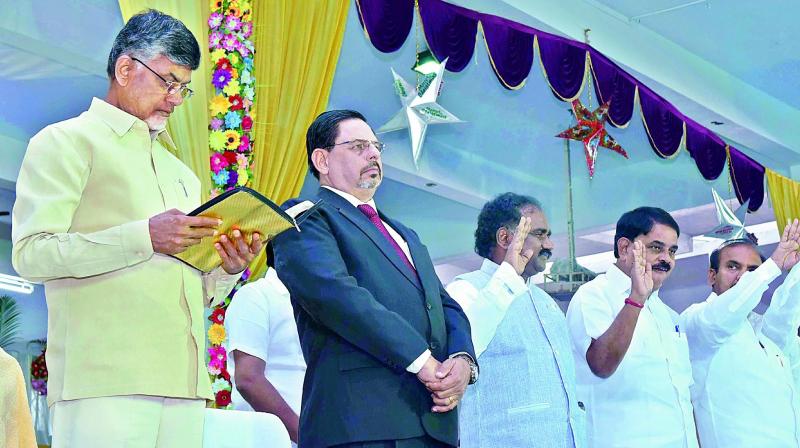
Chief Minister N. Chandrababu Naidu takes part in  X-mas celebrations at Pedakakani in Guntur district.
Guntur: The AP government has increased allocation of funds for construction of churches. Chief Minister N. Chandrababu Naidu, who participated in the Christmas celebrations at Swasthisala at Kakani in Guntur district on Sunday, handed over the copy of a GO, which stated that the funds for construction of a church have been increased from Rs 1 lakh to Rs 3 lakh, to the Christian community elders. Mr Naidu recited holy verses from the Bible and explained about the motto of Christianity to the devotees on the occasion.
Mr Naidu, quoting the words of Mother Theresa, “Not all of us can do great things but we can do small things with great love”, urged the people to collectively working for the development of the society which, in turn, would  develop the state.He said that no other state in India was offering gifts to the poor on every festival, except AP. The TD government has offered Chandranna Christmas Kanuka to Christians with an expenditure of Rs 334 crore.
He said the  state government had spend Rs 57 crore for the welfare of Christians and increased aid for Jerusalem pilgrimage to Rs 40,000 from Rs 20,000. Responding to the request of the Swasthisala organisers about providing special train to Kakani on Monday and Saturday, Mr. Naidu said that public in large numbers visit the Swasthisala on both the days and so, the APSRTC will increase the number of bus services. He also promised about taking the issue of special train to the notice of the railway department. He assured the community  of protecting the assets of churches.

Reference:

http://www.deccanchronicle.com/nation/current-affairs/261216/ap-government-increases-funds-to-churches.html

Chandrababu Naidu doubles financial assistance for Jerusalem pilgrimages to Rs 40,000

GUNTUR: The State government has enhanced financial assistance for Christians, who go on a pilgrimage to Jerusalem, from `20,000 to `40,000 per person. Further, it has increased financial aid for construction of churches from the present `one lakh to `three lakh. Chief Minister N Chandrababu Naidu made the announcement and handed over copies of government order to the Bible Mission organiser J Samuel Raj and other Christian elders during the Christmas celebrations organised at Swasthi Sala in  Pedakakani, Guntur district on Sunday.
Naidu also participated in mass prayers held on the occasion and read out a stanza from the Bible presented to him. Later addressing the audience, he said Jesus Christ was born to spread love, peace and affection among the people and showed the right path to humanity through his life. He appealed to the people to try and spread peace for the welfare of mankind.
Elaborating on the welfare measures launched by his government, the CM pointed out that AP had been facing a severe financial crisis ever since the State was divided in 2014. “But we never compromised on welfare activities, especially those meant to help the poor and the downtrodden. Despite financial constraints, the state government has allocated `57 crore for the upliftment of the Christian community and sanctioned another `13 crore for the welfare of the Christian poor,” he said.
Naidu also recalled that the state government had distributed essential commodities worth `334 crore through the Chandranna Kanuka to the people across the state.
“The government is already taking care of the Christian community’s assets in the State. We will soon submit a proposal to the Railway Ministry to arrange a special train to stop at Padakakani Swasthi Sala and also provide special buses on Monday and Saturday. Priority will be given to sanction funds for churches online,” he promised.

Reference:
http://www.newindianexpress.com/states/andhra-pradesh/2016/dec/26/naidu-doubles-financial-assistance-for-jerusalem-pilgrimages-to-rs-40000-1553102.html

Urban development department to develop five Muslim dominated areas in Mumbai and 10 such in Maharashtra.

The Maharashtra government has asked the Urban development department to identify five Muslim dominated areas in Mumbai and 10 such areas in rest of Maharashtra that lack basic urban facilities like roads, water, sewerage etc. The department has been asked to provide all facilities in these areas as part of government's newly launched scheme that aims at social integration of minority community by improving their financial, social and educational scenario. Sources said this would be an annual feature and every year 15 minority dominated areas will be picked up for civic work.

Source:
http://www.dnaindia.com/india/report-maharashtra-government-to-develop-minority-dominated-areas-2234848
Year: 2016
The scheme has picked up several departments — urban development, education, higher and technical education, skill and development, women and child development and health – who have been assigned specific guidelines vis-à-vis minority community.
The scheme has also asked education department to introduce Urdu as an optional subject in at least 100 government schools. "There is demand for a lot of people wanting to learn Urdu language but it is not taught in most government schools. Under this scheme if 20 and more students are willing to learn the language the government will provide for a teacher," said a senior officer.
Interestingly, as first step towards "deradicalisation of Muslim youth" the scheme which was earlier named as "deradicalsation of Muslim youth" has been left unnamed now. Sources claim that chief minister was apprised of repercussions of the name of the scheme which suggested that the entire 'Muslim youth' is radicalised. For now, the scheme launched a day before Eid has been launched aiming at improving financial, social, and education scenario of Youth belonging to minority community to promote harmony in society.
Finding a direct link between growing radicalization and sense of alienation/discontent amongst youth of minority community, the Maharashtra government's home department had conceived the idea to bring Muslims into the mainstream. It was conceived around June 2015 after a couple of Muslim boys were caught on their way to join ISIS. The scheme, however, was handed over to the minority department midway due to implementation technicalities.
Minority scheme guidelines for selected departments:
School education and sports department:-
  • Prepare a plan to reduce drop out of minority students from schools from Class V onwards. The project plan to be implemented in four minority dominated districts of Maharashtra—Hingoli, Yavatmal, Buldhana and Washim.
  • Encourage Muslim families to send their children to government schools
  • Ensure easy availability of Urdu text books in market.
  • Simplify scholarship norms to encourage more and more minority students to avail them
  • Math's and science teachers to be appointed in Urdu schools
  • Marathi teachers/classes be provided in Urdu schools to help students integrate into mainstream government schools at a later stage
  • Construct toilets in girls government schools in minority dominated areas
  • Hold workshops to encourage Muslim youth to participate in sports

Higher and technical education department
  • To start new Science, commerce and arts colleges in Muslim dominated areas
  • To start special second shift for minority students in government polytechnic

Urban Development Department
  • To identify five Muslim dominated areas in Mumbai and 10 such areas in rest of Maharashtra that lack basic urban facilities like roads, water, sewerage etc. and provide them with all urban facilities
  • To address the sewerage and gutter leak problems in all minority dominated areas
  • To improve water supply in minority dominated areas such as Mumbra where water supply is extremely scarce

Skill development
  • All ITI's to start second and third shifts for minority students
  • To construct new it is for minority concentrated areas
Women and Child development department
  • To start more Anagnwadis in minority areas
  • Employee at least one women from minority dominated areas in these Anganwadis
Public Health department
  • Ensure appointment of at least one female gynecologist in primary health centers situated in minority areas
  • Increase the numbers of Asha Sevika (trained women who work as an interface between the community and the public health system) in minority dominated areas

Maharashtra State Government Scholarship Majorly for Muslims - Directorate of Technical Education

Objective
The objective of the Scheme is to provide financial assistance to the poor and meritorious students belonging to minority communities to enable them to pursue professional and technical courses.

Government webstie reference:

http://dtemaharashtra.gov.in/scholarships/InformationPages/Objective.aspx?SchType=SGS


Scope

Scope
These scholarships are available for studies in India only and will be awarded through an Agency designated by the State Government/UT Administration for this purpose.


Number Of Scholarship

Number of scholarship
21,748 State Scholarship will be distributed among the students of minority communities throughout the State. Based on the population of these communities, the distribution of scholarship will be as under :


Maharashtra State distribution of scholarships:-
For Medical CoursesFor Technical & Other Courses
MuslimsChristiansBuddhistsSikhsParsisJainsMuslimsChristiansBuddhistssikhsParsisJains
5456030510107054506003050100100700


Conditions

Conditions for Scholarship:

i) Financial assistance will be given to pursue degree and/or post graduate level technical and professional courses from a recognized institution. Maintenance allowance will be credited to the student’s account. The course fee will be paid by the State Department directly to the institute concerned.

ii) Students who get admission to a college to pursue technical/professional courses on the basis of a competitive examination will be eligible for the scholarship.

iii) Students who get admission in technical/professional courses any competitive examination will also be eligible for scholarship. However, such without facing students should have not less than 50% marks at higher secondary/graduation level. Selection of these students will be done strictly on merit basis.

iv) Continuation of the scholarship in subsequent years will depend on successful completion of the course during the preceding year.

v) A scholarship holder under this scheme will not avail any other scholarship/stipend for pursuing the course.


vi) The annual income of the beneficiary/parent or guardian of beneficiary should not exceed Rs.2.50 lakh from all sources.

vii) The state department will advertise the scheme every year latest by 31st March and receive the application through the concerned institutions. 

viii) After scrutinizing the applications, the state department will prepare a consolidated budget for all eligible students and send an application in the prescribed pro-forma for release of fund from the Ministry of Minority Affairs for distribution of scholarship giving the details of each students viz. name, permanent address, telephone number, annual course fee, name & address of institute, whether hostler or day-scholar, etc.

ix) The application for release of fund from the state department must be received in the Ministry by 30th of September every year. 

x) The state department will maintain separate bank account and records relating to the funds received from the Ministry and they will be subjected to inspection by the officers of the Ministry or any other agency designated by the Ministry.

xi) The fund for distribution of scholarship in subsequent year will be released after receiving the utilization certificate for the previous year. Annual inspection by the officers of the Ministry or any other agencies designated by the Ministry will also be carried out.

xii) 30% scholarship will be reserved for girls of each minority community in a state which is transferable to male student of that community in case of non-availability of female candidate in that community in the concerned state. 

xiii) If the target for distribution of scholarship to a particular minority community in a state/UT is not fulfilled, it will be distributed among the same minority community of other States/UTs strictly in accordance with the merit.

xiv) A student residing in a particular State/UT will be entitled for scholarship under the quota of that State/UT only irrespective of his place of study.

xv) The number of scholarship has been fixed state-wise on the basis of minority population of the states/UTs. Within the state-wise allocations, the applications from reputed institutions will be exhausted first. The list of such institutions will be made available by the Ministry of Minority Affairs. 

xvi) The scheme will be evaluated at regular intervals and the cost of the evaluation will be borne by the Ministry of Minority Affairs under the provision of the scheme. An additional provision of 3% of the total budget will be made to meet the administrative and allied costs viz. expenditure on monitoring of the scheme, impact study, evaluation study, purchase of office equipments, engaging of contract employees, if necessary and other expenditure to run the cell etc. This will be shared between the Ministry of Minority Affairs, Government of India and the State Governments/UT Administration.


Rate Of Scholarship


Payment:

Payment:

i) Maintenance allowance is payable from 1st April or from the month of admission, whichever is later, to the month in which the examinations are completed, (including maintenance allowance during holidays) maximum twice a year, provided that if the scholar secures admission after the 20th day of a month, the amount will be paid from the month following the month of admission.

ii) In case of renewal of scholarships awarded in the previous years, allowance will be paid from the month following the month upto which scholarship maintenance was paid in the previous year, if the course of study is continuous.

iii) The Government of the State/Union Territory Administration, to which they belong, in accordance with the procedure laid down by them in this regard, will pay the scholarship money to the selected students. 

iv) Scholarship will not be paid for the period of internship/housemanship in the M.B.B.S. course or for a practical training in other course if the student is in receipt of some remuneration during the internship period or some allowance/stipend during the practical training in other course.


Other Conditions For The Award:

Other Conditions:

i) The scholarship is dependent on the satisfactory progress and conduct of the scholar. If it is reported by the Head of the Institution at any time that a satisfactory progress or has been guilty of misconduct such as resorting to or participating in strikes, irregularity in attendance without the permission of the authorities concerned etc., the authority sanctioning the scholarship may either cancel the scholarship or stopor withhold further payment for such period as it may think fit. 

ii) If a student is found to have obtained a scholarship by false statement, his/her scholarship will be cancelled forthwith and the amount of the scholarship paid will be recovered, at the discretion of the concerned State Government. The student concerned will be blacklisted and debarred for scholarship in any scheme forever.

iii) A scholarship awarded may be cancelled if the scholar changes the subject of the course of study for which the scholarship was originally awarded or changes the Institution of study, without prior approval of they State Government. The Head of the Institution shall report such cases to them and stop payment of the scholarship money. The amount already paid may also be recovered at the discretion of the State Government.

iv) A scholar is liable to refund the scholarship amount at the discretion of the State Government, if during the course of the year, the studies for which the scholarship has been awarded, is discontinued by him/her.

v) The regulations can be changed at anytime at the discretion of the Government of India.


Procedure For Applying

Procedure:

i ) An application for scholarship should comprise:

a) One copy of the application for scholarship in the prescribed form (separate application forms prescribed for ‘fresh’ and renewal of scholarship by the concerned States/UTs).
b) One copy of the passport size photograph with signatures of the student thereon(for fresh scholarship). 
c) One attested copy of certificates, diploma, degree etc. in respect of all examinations passed.
d) An income declaration by the self-employed parents/guardians, stating definite income from all sources by way of an affidavit on non-judicial stamp paper. Employed parents/guardians are required to obtain income certificate from their employer and for any additional income from other sources, they would furnish declaration by way of an affidavit on non-judicial stamp paper.
e) Proof of permanent residence.
f) A receipt in acknowledgement of the scholarship in the previous year on the form attached to the application duly counter-signed by the Head of the Institution concerned, if the application was in receipt of a scholarship under this scheme in the preceding year.
g) The State department should satisfy itself that the student belongs to a particular minority community.
ii) Application complete in all respects shall be submitted to the Head of the Institution, being attended or last attended by the candidates and shall be addressed to an officer specified for this purpose by the Government of State/ Union Territory to which the student belongs, in accordance with the instructions issued by them from time to time.


Funding Pattern Of The Scheme:

Funding Pattern :
The Scheme will be implemented by the State Governments and Union Territory Administrations,which receive 100% central assistance from Government of India for the total expenditure under the scheme.